By Deborah Foy, Agricompas
The Reading Cocoa Group is a globally important centre for cocoa research and a leading force behind the development of more sustainable cocoa farming practices. Led by Professor Paul Hadley, the Reading Cocoa Group focusses on quantifying yield-determining processes in cocoa, particularly in the context of climate change. A key focus is higher productivity and greater resilience to unfavourable climatic conditions.
In December 2019, Professor Paul Hadley and colleagues joined a field trip to Colombia. They participated in high-level discussions with Agrosavia around the impact of climate change on cacao production and travelled to Rionegro in Santander to meet farmers and partners participating in the ‘Digitisation of Cacao’ project.
Led by Agricompas, ‘Digitisation of Cacao’ is funded by the Prosperity Fund’s AgriTech Catalyst. The project aims to use digital technologies to boost Colombia’s huge potential to become a major global cocoa producer. The University of Reading is a key partner in this innovative, multi-stakeholder partnership. Over a period of 18 months, the University will bring its international expertise in crop modelling to improve the sustainability of the cocoa sector in Colombia.
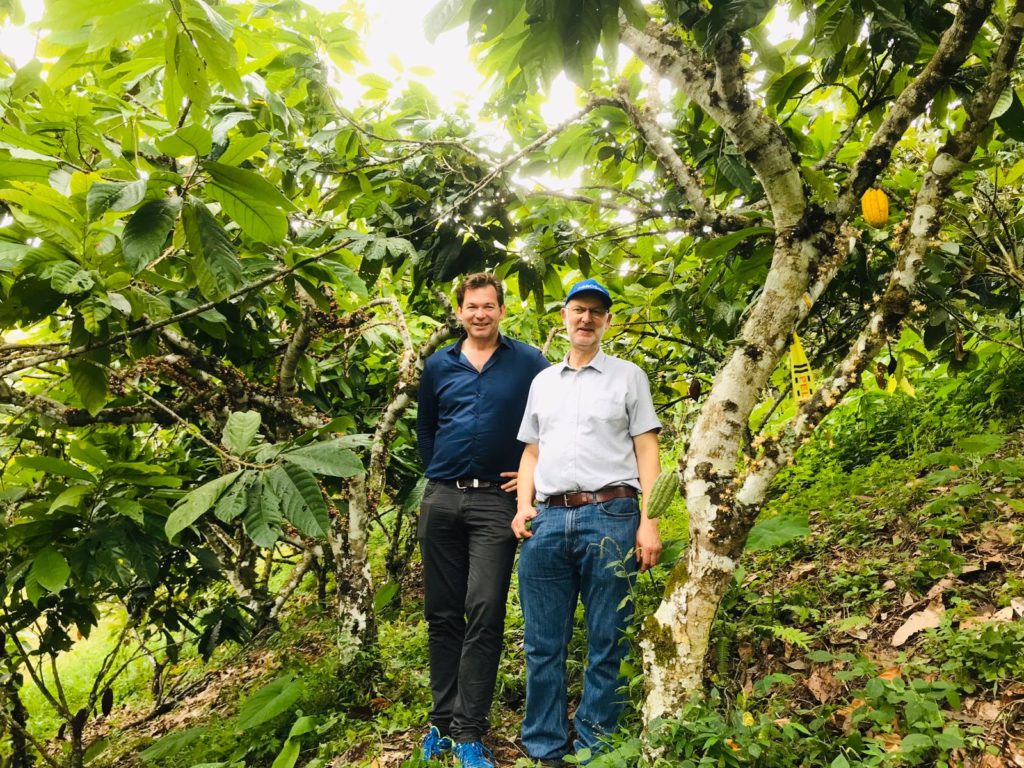
Professor Hadley comments: “Cacao farmers in Colombia are hampered by a lack of scientific knowledge and analysis on the crop at farm level. The platform being developed by the project partners will allow for the storage, monitoring and analysis of various climatic and soil factors – all of which have the capacity to influence the optimal growth and production of cacao. Combined with further advances in machine modelling and artificial intelligence, this will enable farmers to optimise cocoa production, enhancing their commercial viability.”
Professor Hadley continues, “It’s exciting to see the potential that is realised when you harness the power of data. But in tropical environments such as the ones I visited on my trip to Colombia, collecting accurate data is not without its challenges. We’re working alongside other partners in the consortium – and applying the latest in digital technologies – to see how best we can respond to this challenge and translate data into knowledge and insight.